
It can be confusing to decipher an electricity bill in Denmark. But once I figured it out, I was able to save tens of kroner each month. In this guide, I’ll walk you through exactly how to understand your electricity bill step by step and share actionable tips to save money—without changing your consumption habits.
Your electricity bill is made up of your energy consumption (about 20-30% of the bill) and tariffs / taxes (70-80%). Tariffs from the grid company and Energinet are fixed and independent of your electricity provider. You can save money by reviewing your contract for costs like the kWh-price surcharge and the subscription fee.
Breaking down your electricity bill
One bill, several actors
Before we look at the different costs, it is important to understand that these are divided between several actors:
-
Elselskab: The electricity provider that you have a contract with (e.g., Andel Energi, OK, EWII…)
-
Netselskab: The grid company that owns the cables through which electricity is transmitted to your home (the electricity grid)
-
Energinet: Denmark’s system operator, which will often be referred to as TSO in the bill
-
The State
You are free to choose the electricity provider, but not the grid company. The different grid companies in Denmark cover different parts of the country. You might know Radius, who cover the Greater Copenhagen and parts of Sjælland.
What your electricity bill is made of
In Denmark, your electricity bill is the sum of the costs related to your electricity consumption, transport and subscription fees, and taxes to the state.
If I look at my last bill, the costs are divided as follows:
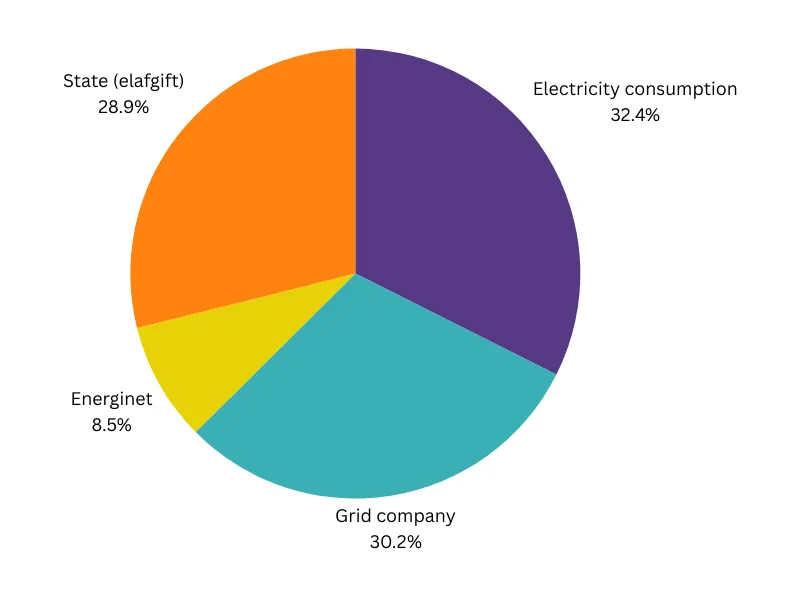
Let’s break down the different costs. Note: There is no standard format for electricity bills in Denmark. Some providers aggregate fees on your bill for simplicity, but it makes it harder to know what is what. If you decide to gloss over this part, a key takeaway is that some fees are regulated by actors outside of your control.
Costs related to your electricity supplier
-
Electricity consumption: This can be called very differently depending on the supplier. Sometimes, it’s the name of your contract (e.g. “OK El Flex”). It is usually the largest unique post, calculated as your consumption in kWh multiplied by the price of a kWh during the billing period.
-
Subscription fee to the energy supplier: Look for “abonnement” and the name of your supplier. This is a fixed fee based on your contract and is independent of your electricity consumption: the price is the same however much or little electricity you use.
Costs related to the grid company
- Netabonnement and nettarif: The netabonnement is a fixed subscription fee and the nettarif is a price per consumed kWh. The nettarif varies per season and time of day. These costs are decided by the grid company and can be reevaluated several times a year.
You can find the current prices on the website of your grid company.
Costs related to Energinet
-
Nettarif (grid tariff): Energinet’s costs for operating and maintaining the main electricity grid. It is a fixed fee per consumed kWh.
-
Systemtarif (system tariff) and systemabonnement (system subscription): Energinet’s costs for supply security and the quality of electricity supply. The tariff is a fixed fee per consumed kWh and the subscription is a fixed fee independent of your consumption.
You can find the current prices on Energinet’s website.
Taxes to the state
- Elafgift: The electricity tax, which is a fixed fee per consumed kWh. It is decided by the state and is reevaluated once a year. In 2025, the tax is 0.72 kr./kWh.
An note on prepaid payment
Some electricity providers offer prepaid contracts. Each month, you pay an estimated amount based on your expected consumption and the expected price of electricity for next period. You also get a statement for last period’s consumption, where you can see if you have paid too much or too little and adjust the payment for the next period.
If you have a prepaid contract, you’ll usually see words like “aconto”, “forskud” or “forudbetaling” on your bill.
Here’s the opinion you haven’t asked for: I don’t like prepaid contracts. I used to have one - a quarterly prepaid contract at that - and I found it hard to keep track of. When I finally decided to switch providers, the final statement was a pain to understand. There’s no advantage for you to have a prepaid contract, they are just a way for the provider to have a more stable cash flow.
Where can you save money on your electricity bill?
Obviously, the most effective way to save money on your electricity bill is to reduce your consumption. However, there are other ways to save money without changing your habits.
Fixed or variable price
When you sign a contract with an electricity provider, you can choose between a fixed or a variable price. With a fixed price, you pay the same price for electricity during a specific period. With a variable price, the market (Nordpool) sets the price so it will be different hour by hour.
When it comes to saving money, the reasoning for choosing between the two depends on your risk aversion. If you choose a fixed price, you know exactly how much you will pay each month (assuming your consumption is stable, of course), but you don’t take advantage of low prices on the market. If you choose a variable price, you can benefit from lower prices when the market price of electricity is low. However, you also risk paying a lot more than fixed-price people when the market price is high.
For a detailed guide, check out: Fixed or Variable Electricity Plans in Denmark: How to Choose.
Subscription fees and “tillæg”
As we saw previously, the subscription fee is a fixed cost that you pay to your electricity provider. It is independent of your consumption. If you have a low consumption, the subscription fee can represent a significant part of your bill.
If you have a variable price, the kWh-price will be the price on the market (“spotpris”) plus a “tillæg” (surcharge) from your electricity provider. Some providers do not have a surcharge and only charge the market price.
Generally, a provider who does not add a surcharge will have a higher subscription fee, and vice versa.
So contrary to what one might think, a surcharge does NOT necessarily mean a higher bill. A rule of thumb is that if you have a low consumption, you should choose a provider with a low subscription fee (or no subscription fee) even if it means a higher surcharge. On the other hand, if you have a high consumption, you should choose a provider with a low surcharge.
We can demonstrate this with an example based on my actual previous and current contracts:
-
Average market price (assumed): 0.8 kr./kWh
-
Low consumption: 100 kWh/month
-
High consumption: 500 kWh/month
-
I do not include the other costs (tariffs and taxes) for simplicity, since they are the same for both contracts
| Contract | Consumption | Surcharge | Subscription fee | Total cost |
|---|---|---|---|---|
| Previous | 100 kWh | 0 kr./kWh | 29 kr./month | 109 kr. |
| New | 100 kWh | 0.1 kr./kWh | 0 kr./month | 90 kr. |
| Previous | 500 kWh | 0 kr./kWh | 29 kr./month | 429 kr. |
| New | 500 kWh | 0.1 kr./kWh | 0 kr./month | 450 kr. |
Payment method
Depending on the provider, you might be able to pay via:
-
Betalingsservice
-
Automatic card payment
-
Receive a bill in your e-Boks with a Girokort (payment slip)
-
MobilePay
These methods can have different fees associated. It is usually not a lot, less than 10 kr./month. But if you have a low consumption, it can be a significant part of your bill, so it’s worth checking.
By paying attention to all these aspects, you can potentially shave off tens of kroner from your electricity bill, either via a different contract with your current provider or by switching providers altogether.
I hope you can use these tips to save money on your electricity bill.