
Are you struggling to figure out whether a fixed or variable electricity plan is better for you? In 2022, electricity prices went through the roof during an energy crisis. Like many other people in Denmark, I considered a fixed plan to lock in the kWh-price with my supplier. After digging into the details, I’ve found there’s no one-size-fits-all answer — but there is a right choice for your situation. In this post, I’ll break it down so you can make the smartest decision for you and your household.
A fixed-price electricity plan offers a stable rate per kWh, providing budget predictability but may cost more if prices drop. A variable-price plan fluctuates with the market, offering potential savings during low-price periods but higher costs during spikes. In the long run, variable plans tend to be cheaper.
What is the difference between fixed and variable plans?
As mentioned above, a fixed-price electricity plan (“fastpris aftale”) means you pay the same rate per kWh to your supplier over the duration of your contract, regardless of fluctuations in the electricity market. Generally, the longer you fix the price, the lower it is.
A variable-price electricity plan (“variabel aftale”), on the other hand, fluctuates hour by hour based on market prices. The price is determined by supply and demand can vary a lot depending on the time of the day, the season and the weather. When electricity is cheap, you can save money; however, when prices rise, so do your costs. They are sometimes also called “spotpris” plans, as the price is based on the spot price of electricity on the Nordpool market.
Whether or not your kWh-price is fixed through your supplier, you also pay a “nettariff”. This is a fee you pay to the grid company (via your electricity bill) for transporting electricity to your home. The price of transport varies during a day and depending on the season and is not fixed even if you have a fixed-price electricity plan. This means that there are variations in what you’ll pay each month even on a fixed plan.
If you’re a bit confused about those different fees on your bill, I have written a guide: Understand your electricity bill in Denmark and save money.
Best of both? : EWII currently (January 2025) has a plan called Prisloft, where you get a variable plan but with a price cap, i.e. a maximum price per kWh. This way, you can benefit from low prices on the market but you’re a bit more secured against ever-increasing prices. This is not a recommendation, as I have not looked into the details of the plan, but worth knowing it’s an option.
Can it pay off to choose a fixed-price electricity plan?
There are pros and cons to both fixed and variable plans.
With a fixed-price plan, assuming that your consumption is stable, you know more or less what you’ll pay for electricity each month over the contract period. This means that you’re able to budget accordingly and this can provide peace of mind. If you believe that electricity prices will rise significantly in the coming months, a fixed-price plan can be a good idea.
On the other hand, you lock yourself on a price that might be good now, but on average too high in the long run. You risk paying more than you would have with a variable plan if the market price of electricity drops significantly. Keep in mind that electricity suppliers buy electricity at market prices and add a margin to cover their costs and ensure they are profitable. In a way, you’re paying a risk premium for the stability of a fixed price.
New in 2025: From January 2025, electricity providers with more than 200,000 customers must offer a fixed-price contract of minimum one year. This was decreed by the Ministry of Climate and Energy. I checked on January 23 on Norlys’ and EWII’s websites as an example, and the offer is indeed available at both suppliers. Although it’s not made very visible on Norly’s website (one line at the bottom of the webpage).
All in all, it is smart to check whether you are committed to a fixed-price plan and for how long. For example, some providers offer fixed-price plans that you can cancel with one month’s notice or . This way, if electricity prices drop significantly, you can switch to a better deal.
Is it a good idea to choose a variable electricity plan?
Variable-price plans are generally cheaper in the long run, especially if you can adapt your consumption to take advantage of low prices during the day. You can follow the electricity price on your supplier’s website or app, or use an 3rd party app like Elpriser or Watts.
According to Forbrugerrådet, as a rule of thumb, electricity is most expensive between 5 and 9 PM (when most people are home and cooking dinner). It is cheaper:
-
Between 11 AM and 2 PM and between 1 and 4 AM
-
During the weekend, especially on Sundays
-
At night in the winter
-
During the day in the summer
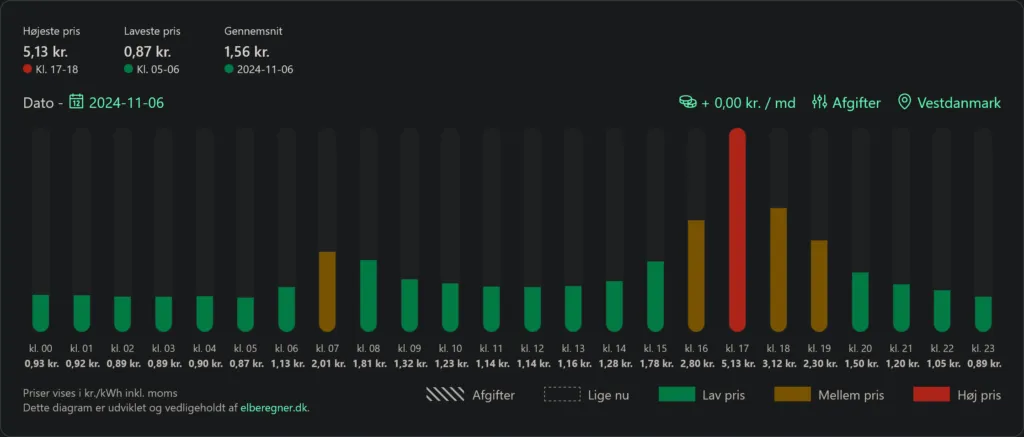
Electricity prices can vary significantly during a day (image: elberegner.dk)
Obviously, like in 2022, market prices can rise significantly and your electricity bill as well. In those cases, it is even more important to keep an eye on the prices and use the washing machine when the price is lower.
How to choose between a fixed or variable plan? It depends.
Choose a fixed price if:
-
You value stability and want to avoid surprises in your electricity bills.
-
Your household has limited flexibility in energy usage (e.g. if little Theo needs his dinner at 18 sharp).
-
You believe electricity prices will rise significantly during the contract period.
-
You can’t be bothered to monitor electricity prices and adjust your consumption patterns.
Choose a variable price if:
-
You can adapt your consumption to take advantage of lower prices during off-peak hours.
-
You’re willing to monitor prices and adjust usage patterns accordingly.
-
You’re willing to take on the risk of higher prices during peak hours and in the future.
Tips
-
Monitor electricity rates: Apps like Watts or Elpriser or your supplier app (if they have one) can help you track hourly prices for variable plans.
-
Check your plan: Pay attention to how long you commit to a plan, be it fixed-priced or variable. Whatever you decide, it is nice to have the flexibility to switch if your needs or the market situation change.
-
What’s in a name: Even if your supplier calls their plan “spotpris”, it does not mean that you pay the same price as the market price. It means that it will follow the fluctuations of the market price. The kWh-price you pay is determined by your supplier and they’ll usually add a “(spot)tillæg” - a surcharge. You can read more about this in my article about understanding your electricity bill.
I hope this article has made you wiser about the differences between fixed and variable electricity plans, and that you now have a better idea of which one is right for you!